
5 Ways to Shorten a Microsoft Dynamics 365 Implementation Timeline Without Cutting Quality
Introduction
ERP implementation requires planning, alignment, and disciplined execution. When organizations begin discussing stronger financial control, improved inventory visibility, and more reliable reporting, Microsoft Dynamics 365 often becomes part of that conversation.
Soon after, leadership usually asks the same practical question:
“How long will this take?”
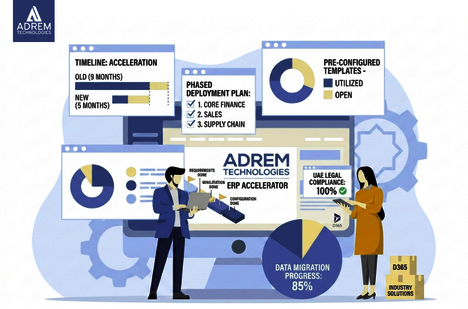
For many mid-sized organizations, implementation timelines range between six and nine months, depending on complexity, integrations, and data readiness. While the long-term benefits are significant, extended timelines can place pressure on day-to-day operations.
Finance teams still need to close books monthly. Sales teams depend on accurate dashboards. Operations teams manage processes that cannot simply pause.
Therefore, the topic “5 Ways to Shorten a Microsoft Dynamics 365 Implementation Timeline Without Cutting Quality” has become increasingly relevant for companies across the UAE.
Organizations want modern systems, but they also want predictable implementation cycles.
With structured planning and disciplined execution, ERP deployments can move faster without sacrificing stability. Implementation partners such as Adrem Technologies help companies across the UAE apply proven frameworks that balance speed with reliability.
Let us explore how.
A Quick Look at Timeline Reality
Before discussing improvements, it helps to understand where time is typically spent during ERP deployment.
| Implementation Phase | Traditional Duration | Optimized Duration |
|---|---|---|
| Requirements & Workshops | 6–8 weeks | 3–4 weeks |
| Configuration | 8–12 weeks | 5–7 weeks |
| Data Migration | 4–6 weeks | 2–3 weeks |
| Testing | 4–6 weeks | 3–4 weeks |
| Go-Live Preparation | 3–4 weeks | 2–3 weeks |
| Total Timeline | 6–9 months | 3–5 months |
The improvement does not come from rushing. Instead, it comes from removing inefficiencies.
1. Define Scope Clearly From the Beginning
ERP projects often slow down because requirements expand during implementation. A small additional workflow here or a custom report there may seem harmless. However, each change triggers configuration adjustments, testing cycles, and documentation updates.
This phenomenon is known as scope creep.
Common examples include:
-
Late integration requests
-
Additional approval workflows
-
New reporting dashboards
-
Extra data migration requirements
To speed up implementation, organizations should define scope early and maintain discipline.
Key steps include:
-
Establishing clear business objectives
-
Defining phase-one deliverables
-
Documenting what will not be included initially
-
Freezing scope before configuration begins
Companies in the UAE that maintain strong scope discipline consistently experience faster ERP deployment cycles.
2. Use Standard System Capabilities Before Customizing
Many organizations assume customization automatically improves control. However, Microsoft Dynamics 365 already includes mature financial, supply chain, and operational processes built from global industry practices.
Rebuilding these standard capabilities often creates unnecessary complexity.
To shorten ERP timelines:
-
Evaluate standard system functionality first
-
Customize only when business outcomes require it
-
Avoid replacing stable modules without justification
This approach does not ignore regional needs. Businesses in the UAE must still address requirements such as:
-
VAT compliance
-
Multi-entity reporting
-
Local regulatory alignment
Implementation partners like Adrem Technologies typically begin with a simple question:
“What outcome are we trying to achieve?”
If standard functionality achieves that outcome, additional customization becomes unnecessary.
3. Prepare Data Early
Data preparation is one of the most underestimated factors affecting ERP timelines.
Common data challenges include:
-
Duplicate vendor records
-
Inconsistent item codes
-
Incomplete historical transactions
-
Misaligned chart-of-accounts structures
These issues often surface during testing if they are not addressed early.
Delays caused by poor data quality frequently exceed delays caused by system configuration.
Organizations should therefore begin data cleansing during the discovery phase.
| Risk Area | Without Early Data Work | With Early Data Work |
|---|---|---|
| Duplicate Records | Found late | Resolved early |
| Reporting Errors | Frequent | Minimal |
| Testing Delays | Common | Reduced |
| Go-Live Delays | Likely | Rare |
Early preparation significantly reduces implementation risk.
4. Establish Clear Decision Authority
ERP projects require frequent decisions.
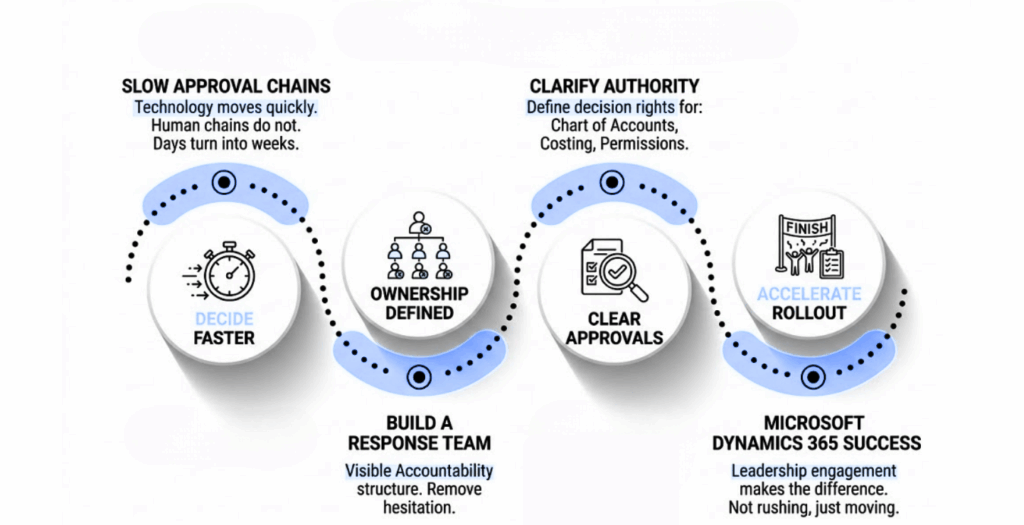
Typical examples include:
-
Chart of accounts structure
-
Approval workflows
-
Inventory costing methods
-
Security permissions
If responsibility for these decisions is unclear, implementation pauses.
To maintain momentum, organizations should define governance early.
Effective governance usually includes:
-
One executive project sponsor
-
One operational project manager
-
Dedicated module owners
-
Fast-response finance representation
When accountability is clear, decisions happen faster and the project continues moving forward.
5. Train Users During Implementation
Many ERP implementations schedule training near the end of the project. While this approach seems logical, it often slows adoption.
A better strategy introduces users to the system during configuration and testing.
Early training allows teams to:
-
Review dashboards sooner
-
Simulate real transactions
-
Identify workflow improvements
-
Build confidence before go-live
Organizations in the UAE often operate with diverse teams and working styles. Some employees prefer documentation, while others learn best through hands-on interaction.
Phased training supports both groups while protecting the timeline.
Implementation partners such as Adrem Technologies integrate user training throughout the project rather than postponing it until the final stage.
The Cost of Delayed ERP Implementation
Long implementation timelines increase operational inefficiencies.
During delays:
-
Manual reconciliations continue
-
Reporting inconsistencies remain
-
Leadership decisions rely on partial data
Industry benchmarks suggest that extended ERP projects can increase operational overhead by 5–10% during transition periods.
For companies operating in competitive UAE markets, these delays carry measurable financial impact.
Implementation Efficiency Overview
| Strategic Action | Timeline Impact | Quality Impact |
|---|---|---|
| Scope Discipline | High | Positive |
| Standard Configuration | High | Positive |
| Early Data Preparation | Medium | High |
| Clear Governance | High | High |
| Phased Training | Medium | High |
Individually, each improvement helps. Together, they significantly accelerate implementation.
Why This Matters Now
Across the UAE, organizations are rapidly adopting cloud platforms to improve transparency, compliance, and operational scalability.
Microsoft Dynamics 365 provides the foundation for this transformation.
However, success depends on structured execution rather than rushed deployment.
Companies that apply disciplined scope management, governance frameworks, and early preparation consistently shorten Dynamics 365 implementation timelines without sacrificing system quality.
Conclusion
ERP implementation does not have to disrupt operations for extended periods.
When organizations combine:
-
Clear scope definition
-
Standard system usage
-
Early data preparation
-
Structured governance
-
Continuous training
implementation timelines shorten naturally.
Companies across the UAE that adopt these structured practices complete projects faster while maintaining reliability and long-term performance.
Through its Microsoft Dynamics 365 implementation services, Adrem Technologies helps organizations apply these proven frameworks, enabling smoother deployments and stronger operational outcomes.
Frequently Asked Questions
How long does a typical Microsoft Dynamics 365 implementation take? Most mid-sized organizations complete implementations within three to nine months, depending on project scope, integrations, and data readiness.
Can the implementation timeline be shortened safely? Yes. Structured planning, disciplined scope management, and early data preparation allow organizations to accelerate implementation without compromising quality.
Is customization always required in Dynamics 365 projects? Not necessarily. Standard Dynamics 365 modules often support most operational processes effectively. Customization should only be introduced when it delivers clear business value.
Why do ERP implementations usually slow down? Common causes include scope creep, unclear decision authority, unprepared data, and delayed stakeholder approvals.
How does Adrem Technologies help with faster implementations? Adrem Technologies supports UAE organizations with structured Dynamics 365 implementation frameworks, focusing on scope clarity, data readiness, governance alignment, and phased training to ensure efficient and stable deployments.
Frequently asked questions
How long does a typical Microsoft Dynamics 365 implementation take?
Most mid-sized organizations complete implementations within three to nine months, depending on project scope, integrations, and data readiness.
Can the implementation timeline be shortened safely?
Yes. Structured planning, disciplined scope management, and early data preparation allow organizations to accelerate implementation without compromising quality.
Is customization always required in Dynamics 365 projects?
Not necessarily. Standard Dynamics 365 modules often support most operational processes effectively. Customization should only be introduced when it delivers clear business value.
Why do ERP implementations usually slow down?
Common causes include scope creep, unclear decision authority, unprepared data, and delayed stakeholder approvals.
How does Adrem Technologies help with faster implementations?
Adrem Technologies supports UAE organizations with structured Dynamics 365 implementation frameworks, focusing on scope clarity, data readiness, governance alignment, and phased training to ensure efficient and stable deployments.
Tags
Author

Sara Adam