
Microsoft Dynamics 365 Finance Implementation: The 2026 Expert Guide to Building a Future-Ready Financial System
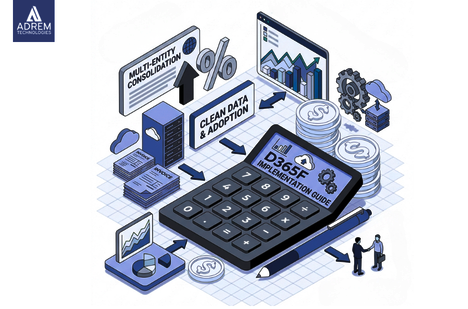
Finance leaders today operate in an environment defined by speed and complexity. At the same time, expectations continue to rise. CFOs must close books faster, manage multi-entity consolidation, maintain VAT compliance across regions, and deliver forward-looking insights to leadership.
However, modern finance is no longer just about reporting yesterday’s numbers. Instead, it has become the strategic core of enterprise decision-making.
That shift explains why Microsoft Dynamics 365 Finance implementation has moved from “IT project” to “board-level priority” in 2026.
Yet there’s an important truth many organizations overlook: powerful software alone does not create transformation. Rather, long-term success depends on structured implementation, clean data, and strong adoption.
This guide walks you through what successful Microsoft Dynamics 365 Finance implementation looks like today, how it integrates with Microsoft Dynamics 365 Sales, and why partnering with Adrem Technologies significantly reduces risk.
What Dynamics 365 Finance Implementation Delivers in 2026
Traditionally, ERP systems focused on accounting accuracy. In contrast, Dynamics 365 Finance delivers strategic clarity.
When properly implemented, it enables:
-
Multi-entity consolidation across regions
-
Multi-currency financial management
-
Automated VAT and tax configuration
-
AI-driven financial forecasting
-
Live cash flow visibility
-
Budget planning and variance analysis
-
Integrated revenue recognition
-
Real-time executive dashboards
Instead of waiting for month-end reports, leadership gains continuous performance visibility. Moreover, because the platform connects directly with Dynamics 365 Sales, revenue data flows automatically into financial projections.
As a result, forecasting becomes proactive rather than reactive.
Why Implementation Quality Matters More Than Ever
Although many enterprises focus heavily on software selection, implementation ultimately determines success.
In fact, most ERP failures stem not from technology limitations but from poor preparation.
Common issues include:
-
Rushed process design
-
Dirty data migration
-
Weak sales-finance integration
-
Over-customization
-
Insufficient training
Conversely, a structured implementation approach provides:
-
One standardized global financial model
-
Automated compliance controls
-
Faster closing cycles
-
Unified sales-to-cash tracking
-
Strong governance across entities
Therefore, implementation should be treated as transformation not configuration.
Adrem Technologies follows a disciplined methodology to ensure operational stability from day one.
Core Functional Areas of Dynamics 365 Finance
Enterprise Financial Capabilities
| Area | What It Covers | Strategic Impact |
|---|---|---|
| General Ledger | Journals, financial dimensions | Accounting control |
| Accounts Payable | Vendor invoicing, workflows | Reduced payment errors |
| Accounts Receivable | Billing, collections | Improved liquidity |
| Budgeting & Forecasting | AI-driven planning | Strategic agility |
| Asset Management | Depreciation tracking | Clean capital reporting |
| Tax Automation | VAT & regional rules | Compliance confidence |
| Project Financials | Revenue & WIP | Services optimization |
Because the platform is modular, implementation can be tailored by industry and geography. Furthermore, built-in scalability allows expansion without rebuilding the system.
The Strategic Role of Dynamics 365 Sales in Finance
Many organizations underestimate the relationship between CRM and ERP.
However, sales forecasting directly influences financial projections. Likewise, inaccurate pipeline reporting distorts cash flow planning.
This is why integration with Dynamics 365 Sales matters.
When properly connected:
-
Sales orders flow directly into finance
-
Revenue recognition schedules automate
-
Credit limits sync across departments
-
Collections visibility improves
-
Forecasting aligns with reality
Through this integration, sales and finance operate as one unified revenue engine.
Adrem Technologies ensures this synchronization occurs at the architecture level not as an afterthought.
The 2026 Implementation Roadmap
A phased roadmap significantly reduces disruption.
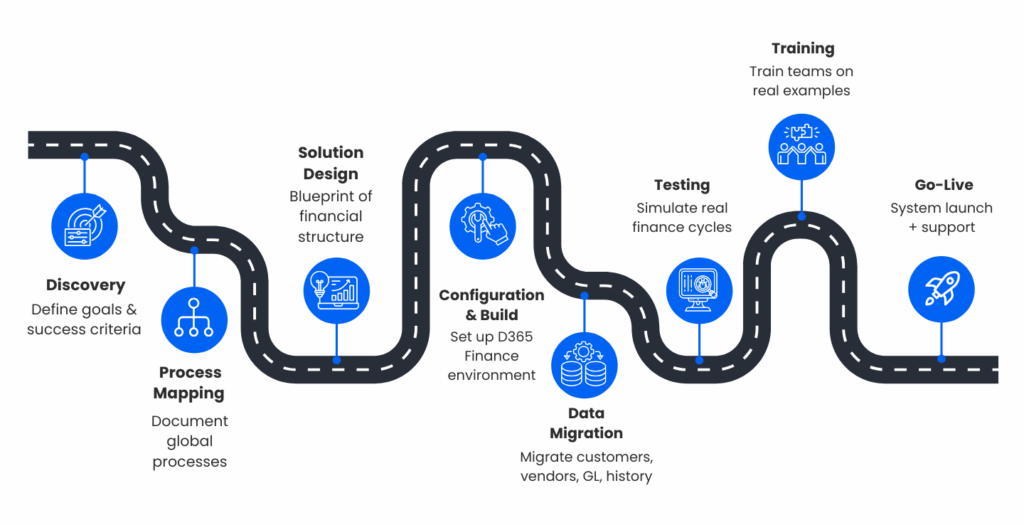
1. Discovery
Initially, measurable goals are defined, such as reducing month-end close by 50%.
2. Process Mapping
Next, global financial workflows are standardized.
3. Solution Design
Then, legal entities, chart of accounts, tax rules, and CRM integrations are architected.
4. Configuration & Build
At this stage, modules are configured without excessive customization.
5. Data Migration
Before go-live, master data is cleaned, validated, and structured.
6. Testing
Afterwards, real-life scenarios simulate full month-end and tax cycles.
7. Training
Meanwhile, teams receive practical, scenario-based training.
8. Go-Live
Finally, operations transition in a controlled release supported by performance monitoring.
Because each phase builds systematically on the previous one, risk decreases while adoption strengthens.
Real-World Implementation Impact
Consider a regional distribution enterprise operating multiple legal entities.
Previously, they experienced:
-
12-day month-end closing
-
Manual intercompany reconciliation
-
VAT compliance anxiety
-
Forecasting inaccuracies
Following a Dynamics 365 Finance implementation led by Adrem Technologies:
-
Month-end reduced to 3 days
-
Consolidation became automated
-
VAT compliance reports generated instantly
-
Sales pipeline fed financial planning models
-
Executives accessed live dashboards
Most importantly, leadership reported improved confidence not just faster reporting.
Common Risks Without Modern Financial Systems
Organizations relying on legacy platforms often face:
-
Fragmented reporting
-
Version control errors
-
Delayed reconciliations
-
Compliance exposure
-
Poor forecasting accuracy
-
Limited scalability
Over time, these inefficiencies compound.
Therefore, modernization becomes less of a luxury and more of a necessity.
Who Should Invest in Dynamics 365 Finance Implementation?
This solution is especially valuable for:
-
Multi-entity enterprises
-
Companies expanding internationally
-
Industries with heavy regulatory oversight
-
Businesses needing live forecasting
-
Organizations already using Dynamics 365 Sales
If finance feels reactive rather than predictive, transformation is likely overdue.
Why Enterprises Partner with Adrem Technologies
Technology enables progress. Execution secures results.
Adrem Technologies provides:
-
Structured ERP methodology
-
CRM–ERP integration architecture
-
Compliance configuration expertise
-
Data migration governance
-
Change management strategy
-
Post-go-live optimization
As a result, organizations achieve both operational control and strategic clarity.
Final Thoughts
Finance in 2026 demands intelligence, speed, and adaptability.
Microsoft Dynamics 365 Finance delivers those capabilities but only when implemented correctly.
When integrated with Dynamics 365 Sales, the enterprise gains a connected digital backbone that unifies revenue, compliance, and operational insight.
Ultimately, success depends less on the software itself and more on the expertise guiding its deployment.
For organizations ready to modernize financial operations with confidence, Microsoft Dynamics 365 Finance implemented by Adrem Technologies provides a future-ready foundation.
Frequently Asked Questions
How long does implementation take? Typically, enterprise deployments range from 4–9 months. However, scope and entity count influence timelines.
Does Dynamics 365 Finance support VAT compliance? Yes. Built-in tax engines handle regional configuration and automated reporting.
Can it integrate with CRM systems? Absolutely. It integrates directly with Microsoft Dynamics 365 Sales for unified revenue tracking.
Is it cloud-based? Yes. Running on Microsoft Azure, it offers enterprise-grade scalability and security.
Why choose Adrem Technologies? Because implementation expertise reduces risk. Adrem Technologies ensures financial models, integrations, and compliance are aligned with real-world business operations.
Frequently asked questions
How long does implementation take?
Typically, enterprise deployments range from 4–9 months. However, scope and entity count influence timelines.
Does Dynamics 365 Finance support VAT compliance?
Yes. Built-in tax engines handle regional configuration and automated reporting.
Can it integrate with CRM systems?
Absolutely. It integrates directly with Microsoft Dynamics 365 Sales for unified revenue tracking.
Is it cloud-based?
Yes. Running on Microsoft Azure, it offers enterprise-grade scalability and security.
Why choose Adrem Technologies?
Because implementation expertise reduces risk. Adrem Technologies ensures financial models, integrations, and compliance are aligned with real-world business operations.
Tags
Author

Sara Adam