
Why Most Microsoft Dynamics 365 Implementations Fail (And How to Avoid It)
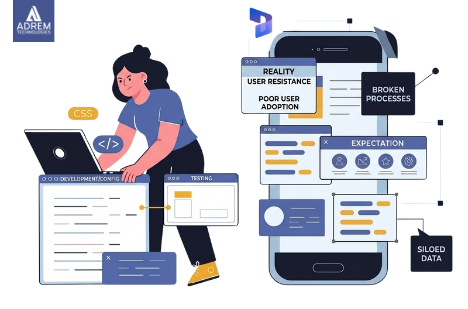
When Expectations Slowly Drift from Reality
At the start of most ERP projects, everything feels aligned. The goals are clear, the system appears capable, and platforms like Microsoft Dynamics 365 promise structure and efficiency.
However, as implementation progresses, subtle challenges begin to surface.
Initially, these issues seem manageable minor delays, small adjustments, or temporary workarounds. Yet over time, the gap between expectations and actual outcomes often widens.
Many organizations, particularly across the United Arab Emirates, move forward without fully aligning their teams, processes, and objectives. As a result, systems go live but fail to deliver their full value.
At Adrem Technologies, this pattern appears frequently. Systems are implemented, but they remain underutilized or disconnected from daily operations.
What Failure Really Looks Like
Failure rarely appears as a sudden breakdown. Instead, it develops quietly over time.
You might notice:
-
Teams returning to spreadsheets
-
Reports taking longer than expected
-
Data inconsistencies creating doubt
-
Users hesitating before using the system
Interestingly, systems do not fail overnight. They slowly lose relevance.
Early Warning Signs
| Signal | What It Suggests | Likely Outcome |
|---|---|---|
| Low daily usage | Lack of user confidence | Gradual disengagement |
| Repeated corrections | Weak setup or unclear workflows | Time loss |
| Data mismatches | Migration or entry issues | Reduced trust |
| User hesitation | Poor adoption | System avoidance |
When Goals Sound Good but Lack Clarity
Most implementations begin with broad objectives:
-
“Improve efficiency”
-
“Increase visibility”
While these goals sound reasonable, they often lack measurable detail.
Without clarity:
-
Teams interpret goals differently
-
Decisions become inconsistent
-
Progress becomes difficult to track
A more effective approach includes:
-
Defining measurable outcomes
-
Aligning expectations across departments
-
Reviewing progress regularly
Clear goals quietly guide better decisions.
The Role of the Implementation Partner
While much attention goes to the software, the implementation partner often determines success.
Some organizations prioritize cost or speed when selecting a partner. Although understandable, this can lead to misalignment later.
A strong partner typically:
-
Understands business processes before configuration
-
Translates operations into system workflows
-
Provides support beyond go-live
Because in reality, implementation does not end at deployment.
When Customization Becomes a Problem
Customization can add value but only when used carefully.
Many organizations attempt to recreate old systems within new platforms. While this feels familiar, it often limits improvement.
Excessive customization can:
-
Increase complexity
-
Slow system updates
-
Create long-term dependencies
A balanced approach works better:
-
Use standard features wherever possible
-
Adjust processes instead of forcing the system
-
Customize only when it adds measurable value
People Matter More Than Technology
Even the most advanced system can fail without user adoption.
Surprisingly, training is often treated as a final step rather than an ongoing process.
However, effective adoption requires:
-
Early user involvement
-
Role-based training
-
Continuous support after launch
Ultimately, systems create value only when people use them confidently.
Data Migration: A Hidden Risk
Although data migration is often considered technical, it has a direct impact on usability.
Legacy data frequently includes:
-
Duplicate entries
-
Missing information
-
Inconsistent formats
If migrated without cleansing, these issues carry forward.
To avoid this:
-
Clean data before migration
-
Validate during transfer
-
Review results carefully
Clean data builds trust from day one.
Mid-Project Risks
| Situation | What Happens | Impact |
|---|---|---|
| Expanding scope | Continuous feature additions | Timeline pressure |
| Miscommunication | Misaligned expectations | Delays and rework |
| Limited testing | Issues discovered late | Frustration |
| Lack of feedback | Users feel excluded | Low adoption |
Change Management: The Human Factor
Change is rarely just technical it is personal.
Different employees adapt at different speeds. Without proper support, even small changes feel disruptive.
Successful transitions typically include:
-
Clear communication
-
Active leadership involvement
-
Ongoing user support
Consistency reduces resistance.
The Risk of Unrealistic Timelines
There is often pressure to move quickly. However, speed can introduce hidden risks.
Rushed implementations usually lead to:
-
Limited testing
-
Incomplete training
-
Missed refinements
Instead, a balanced approach helps:
-
Phased rollouts
-
Time for feedback
-
Flexibility for adjustments
Because unexpected challenges are almost inevitable.
Go-Live Is Just the Beginning
Many organizations treat go-live as the finish line.
In reality, it marks the start of real usage.
Without post-launch support:
-
Issues remain unresolved
-
Confidence decreases
-
Adoption slows
That is why companies like Adrem Technologies emphasize continuous improvement after deployment.
Trends in the UAE Market
Across the UAE, businesses are increasingly adopting:
-
Cloud-based ERP systems
-
Integrated business platforms
-
Data-driven decision-making
However, successful outcomes depend less on the system itself and more on how it is implemented.
Execution makes the difference.
Practical Steps That Drive Success
Instead of overcomplicating the process, focus on what consistently works:
-
Define clear, measurable goals
-
Choose the right implementation partner
-
Limit unnecessary customization
-
Invest in proper training
-
Clean and validate data carefully
-
Support users through change
-
Continuously improve after go-live
A Balanced Implementation Approach
| Phase | Focus Area | Outcome |
|---|---|---|
| Before | Planning and alignment | Strong foundation |
| During | Testing and communication | Stability |
| After | Support and optimization | Long-term success |
Final Thoughts: Making the System Part of Everyday Work
Across organizations, the pattern feels familiar.
The system is capable. The intention is strong. Yet somewhere along the way, alignment weakens.
That is where outcomes begin to shift.
At Adrem Technologies, the focus remains practical:
-
Understand the business first
-
Align the system with real workflows
-
Continue refining over time
Because success does not come from the tool alone.
It comes from how naturally that tool fits into daily operations.
Frequently Asked Questions
Why do Microsoft Dynamics 365 implementations fail? Most failures result from poor planning, weak adoption, and lack of alignment rather than issues with the system itself.
How can businesses improve implementation success? By focusing on clear goals, user involvement, structured processes, and ongoing support.
Is customization always necessary? No. Customization should only be applied when it adds real business value.
Why is training important? Training builds confidence and ensures users can effectively operate the system.
Can small businesses succeed with Dynamics 365? Yes. Success depends on aligning the system with business needs and scale.
** **
Frequently asked questions
Why do Microsoft Dynamics 365 implementations fail?
Most failures result from poor planning, weak adoption, and lack of alignment rather than issues with the system itself.
How can businesses improve implementation success?
By focusing on clear goals, user involvement, structured processes, and ongoing support.
Is customization always necessary?
No. Customization should only be applied when it adds real business value.
Why is training important?
Training builds confidence and ensures users can effectively operate the system.
Can small businesses succeed with Dynamics 365?
Yes. Success depends on aligning the system with business needs and scale.
Tags
Author

Sara Adam