
Ways to Measure ERP ROI Within the First 12 Months of Go-Live
ERP systems rarely arrive quietly.
ERP ROI measurement is one of the first questions leaders ask after an ERP system goes live. For businesses in the UAE, understanding whether an ERP investment is delivering value within the first 12 months is no longer optionait is expected.
They follow months of discussion, comparison, hesitation, and high expectations. By the time go-live happens, teams are usually exhausted, leadership is alert, and finance is watching closely.
Then the real question appears. Not in a slide deck or proposal, but in everyday conversation.
Is this actually working?
For organisations operating in the UAE, that question carries particular urgency. Markets move quickly. Costs shift constantly. Waiting several years to understand value feels unrealistic.
Companies that work with implementation partners such as Adrem Technologies often take a grounded view of ROI. The system does not need to prove everything in year one. However, it should prove something. In most cases, it does.
Early value is not always loud. Instead, it appears in small operational moments. Fewer corrections. Shorter meetings. Clearer numbers. These signals matter.
To build clarity, it helps to understand what typically changes within the first year.
Early Indicators of ERP Value in the First Year
| Area | Before ERP | Within 12 Months |
|---|---|---|
| Month-end close | Slow and tense | Predictable and calmer |
| Inventory records | Often disputed | Largely trusted |
| Reporting effort | Manual and repetitive | Mostly automated |
| Cross-team alignment | Fragmented | Noticeably improved |
These shifts do not occur overnight. Nevertheless, they tend to appear sooner than expected.
Rethinking What Early ERP Returns Really Mean
Measuring success in the first 12 months is not only about money saved.
Cost matters, of course. However, focusing solely on savings can miss other early signals that feel just as real.
A more useful lens is momentum.
-
Is work moving more smoothly?
-
Are fewer people fixing the same problems repeatedly?
-
Are decisions made with less guesswork?
When these answers begin to change, value is forming.
Financial Indicators That Often Appear Early
Finance teams usually notice ERP benefits first. The numbers feel calmer. Less reactive.
Lower Operating Costs
ERP systems replace scattered tools and duplicated processes. Over time, licensing costs reduce, support contracts shrink, and manual reconciliation fades.
Within the first year, many organisations report operating cost reductions between 8 and 15 percent. The exact figure varies, but the direction is usually consistent.
Better Control Over Cash Flow
Delayed invoicing quietly restricts cash.
Because automation shortens billing cycles and highlights overdue accounts earlier, cash positions improve. For that reason, finance teams often track days sales outstanding before and after go-live.
In many cases, improvement becomes visible within the first year.
Fewer Costly Errors
Manual entry creates risk. Pricing errors, duplicate postings, and tax miscalculations add up.
ERP systems reduce these issues. Credit notes decline. Adjustments become less frequent. Although early savings may be difficult to isolate precisely, the trend is clear.
Operational Efficiency as an Early Indicator
Operational inefficiencies rarely stay hidden for long.
ERP implementations tend to surface them quickly.
Shorter Process Cycles
Order-to-cash and procure-to-pay cycles tighten as workflows stabilise. Approvals become visible. Bottlenecks are harder to ignore.
For example, a process that once took ten days may reduce to six or seven. As a result, planning meetings become more focused and less argumentative.
Clearer Use of Resources
With improved visibility, patterns emerge.
Idle equipment. Overloaded teams. Inefficient scheduling. These realities become visible instead of assumed.
Better planning often improves utilisation without additional hiring, which supports measurable returns.
Productivity Gains That Feel Real
Productivity improvements can sound abstract. Until they are experienced.
Less Manual Work
ERP systems eliminate repeated data entry across multiple tools. As spreadsheets fade, teams regain time.
Many organisations recover two to three hours per employee per week. That time shifts toward analysis, customer interaction, or simply breathing room.
Faster Onboarding
Standardised workflows reduce reliance on informal knowledge. New employees learn processes faster and make fewer early mistakes.
For growing companies in the UAE, this advantage compounds quickly.
Customer Experience as an Early Signal
Customers often notice ERP improvements before financial reports reflect them.
More Accurate Orders
Better inventory visibility reduces backorders and incorrect shipments. Consequently, delivery promises become realistic rather than optimistic.
Within six months, customer complaints linked to fulfilment errors often decline.
Faster Responses
Customer service teams gain a complete view of orders, invoices, and deliveries.
As information becomes centralised, calls shorten, follow-ups decrease, and confidence grows on both sides of the conversation.
Data Trust and Reporting Confidence
One of the quietest yet most powerful ERP benefits is trust in data.
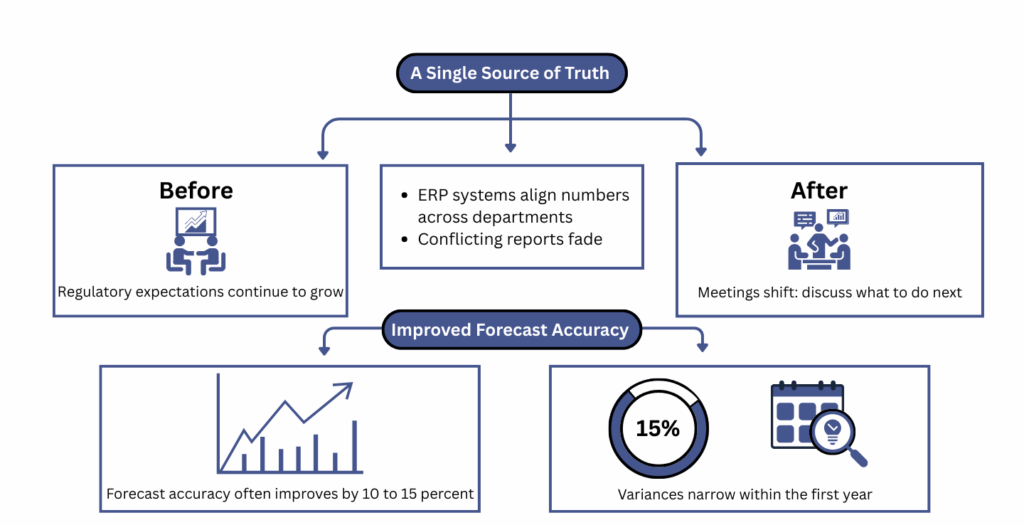
A Single Source of Truth
ERP systems align numbers across departments. Conflicting reports fade.
Instead of debating which figure is correct, meetings shift toward deciding what to do next. That change alone signals value.
Improved Forecast Accuracy
Sales forecasts and inventory projections become more reliable over time. Variances narrow.
Within the first year, forecast accuracy often improves by 10 to 15 percent. Planning begins to feel grounded rather than speculative.
Mid-Year Checkpoint: What Many Teams Review
Between six and nine months after go-live, many organisations pause to review progress.
| Function | Metric | Observed Change |
|---|---|---|
| Finance | Month-end close | Noticeably shorter |
| Operations | Fulfilment cycle | Faster and steadier |
| HR | Payroll accuracy | Few corrections |
| IT | System stability | Fewer disruptions |
These checkpoints often lead to small adjustments that strengthen returns by year-end.
Market Expectations in the UAE
Across the Gulf region, expectations around technology investments have shifted.
Boards increasingly look for measurable progress within twelve months. As a result, ERP implementations in the UAE often prioritise finance automation, compliance readiness, and supply chain visibility.
Although long-term transformation remains important, early signals now carry real weight.
Risk Reduction as a Form of ROI
Risk does not always feature prominently in ROI discussions. Yet it delivers tangible value.
Audit and Compliance Readiness
Improved traceability simplifies audits.
Many organisations report smoother audit cycles and fewer post-audit adjustments within the first year.
Operational Resilience
Centralised systems reduce dependency on individuals. Processes become visible and repeatable.
That resilience proves invaluable during staff turnover or unexpected disruption.
Cultural Shifts as Subtle Indicators
Culture never appears on a balance sheet.
Still, it often reveals system success. Collaboration improves. Accountability becomes clearer. Conversations rely more on data than assumption.
When these shifts appear, the ERP system is becoming part of daily thinking, not just daily processing.
Why Early Returns Sometimes Take Longer
Not every implementation shows fast results.
Common reasons include:
-
Poor data preparation
-
Limited user training
-
Excessive customisation
Organisations that keep systems simple and prioritise adoption usually see value sooner.
A Practical View of First-Year ERP ROI
Before closing year one, many organisations review performance across multiple dimensions.
| Dimension | What Is Observed | Value Type |
|---|---|---|
| Financial | Cost control, cash flow | Direct |
| Operational | Accuracy, speed | Visible |
| Human | Productivity, confidence | Emerging |
| Strategic | Decision quality | Developing |
This balanced view avoids overemphasising a single metric.
Conclusion
Measuring ERP ROI within the first 12 months is not only possible, it is increasingly expected.
Financial stability, operational efficiency, productivity gains, and cultural shifts all provide reliable signals when viewed together. For companies in the UAE, early clarity matters.
ERP systems supported by experienced partners such as Adrem Technologies often reveal value sooner because implementation continues well beyond go-live.
The first year does not tell the whole story. However, it tells enough.
And for most leaders, that early story is exactly what they need to hear.
When should ERP returns be measured? Early indicators often appear within three months, with clearer trends by six to twelve months.
Can ERP results be positive in the first year? Yes. Many organisations see measurable improvements within twelve months.
Which areas show benefits first? Finance and operations typically lead, followed by customer-facing teams.
Is ERP success only about saving money? No. Risk reduction, data quality, and decision confidence are equally important.
How important is post-go-live support? It strongly influences adoption and the speed at which benefits appear.
Frequently asked questions
When should ERP returns be measured?
Early indicators often appear within three months, with clearer trends by six to twelve months.
Can ERP results be positive in the first year?
Yes. Many organisations see measurable improvements within twelve months.
Which areas show benefits first?
Finance and operations typically lead, followed by customer-facing teams.
Is ERP success only about saving money?
No. Risk reduction, data quality, and decision confidence are equally important.
How important is post-go-live support?
It strongly influences adoption and the speed at which benefits appear.
Tags
Author

Sara Adam