
Dynamics 365 Supply Chain: Smarter Operations for UAE Businesses
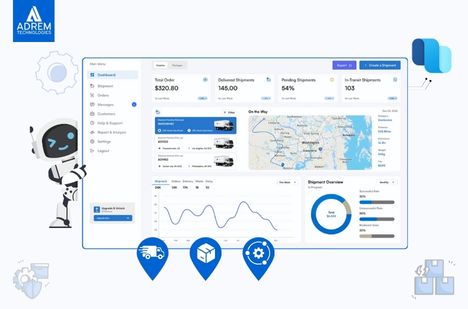
“The smartest supply chains don’t just move goods they move decisions.”
📊 Supply Chain Capabilities at a Glance
| Supply Chain Area | Business Impact |
|---|---|
| Demand Planning | Higher forecast accuracy with AI |
| Procurement | Automated supplier communication |
| Warehouse Management | Real-time inventory visibility |
| Asset Management | Predictive maintenance & improved OEE |
| Risk Management | Faster response to disruptions |
🚀 Introduction: Why Supply Chains Are Changing Fast
Across the UAE, supply chain leaders are dealing with constant change.
Demand fluctuates. Suppliers shift. Logistics costs rise.
As a result, traditional ERP systems are no longer enough.
This is where Dynamics 365 Supply Chain becomes essential. Instead of reacting to problems, businesses can now anticipate and resolve them in advance.
At Adrem Technologies, we see companies transform their operations by turning supply chains into intelligent, AI-driven systems.
🤖 The Moment Everything Changes: AI in Action
Let’s imagine a typical morning.
A supplier delay appears in Shenzhen. However, instead of chaos, your system responds immediately:
-
Supplier communication is already updated
-
Demand buffers are recalculated
-
Alternative sourcing is suggested
-
Production impact is summarized
All of this happens automatically.
That’s the power of Dynamics 365 Supply Chain it works before you even react.
🧠 Smarter Operations with AI Agents
Today, AI agents are reshaping how supply chains operate.
Instead of just analyzing data, they take action.
Key AI Capabilities:
-
Supplier communication automation
-
Demand planning optimization
-
Warehouse insights generation
-
Predictive maintenance alerts
Consequently, teams spend less time on manual tasks and more time on decision-making.
🌍 Why UAE Businesses Are Adopting Dynamics 365 Supply Chain
The UAE is one of the world’s fastest-moving trade hubs.
Therefore, businesses need:
-
Real-time visibility
-
Faster response times
-
Scalable systems
-
Regional compliance support
Dynamics 365 Supply Chain delivers all of this within a single cloud platform.
📦 Demand Planning and Forecast Accuracy
Demand planning is no longer static. Instead, it evolves continuously.
With Dynamics 365:
-
Sales trends update forecasts instantly
-
Seasonal demand is automatically considered
-
Supply constraints are factored in
As a result:
-
Forecast accuracy improves
-
Stockouts decrease
-
Excess inventory is reduced
🏭 Warehouse and Inventory Optimization
Modern warehouses must operate in real time.
With Dynamics 365 Supply Chain:
-
Inventory updates instantly across locations
-
Picking and packing are optimized
-
Managers receive live operational insights
Therefore, decisions become faster and more accurate.
🔧 Asset Management and Predictive Maintenance
Every machine generates data. However, without AI, that data goes unused.
Dynamics 365 changes this by:
-
Monitoring equipment performance
-
Predicting failures early
-
Automating maintenance schedules
Consequently, downtime decreases while efficiency improves.
⚠️ Supply Chain Risk Management
Disruptions are no longer rare they are constant.
However, Dynamics 365 helps businesses stay ahead by:
-
Monitoring supplier performance
-
Tracking logistics risks
-
Suggesting alternative strategies
As a result, operations remain stable even during uncertainty.
🤝 Collaboration Across Departments
Supply chains don’t work in isolation.
Instead, they depend on collaboration between:
-
Finance
-
Procurement
-
Logistics
-
Sales
With Dynamics 365:
-
Everyone works within one system
-
Data is shared in real time
-
Decisions happen faster
📈 Real-World Impact
A global manufacturer improved operations significantly after implementation:
-
Forecast accuracy increased by 22%
-
Downtime reduced by 30%
-
Warehouse efficiency improved by 25%
This shift turned their supply chain from reactive to predictive.
🛠 How to Get Started
We recommend a phased approach:
-
Start with one process
-
Clean your data
-
Train your team
-
Track KPIs
-
Scale gradually
This ensures smoother adoption and better results.
🔮 The Future of Supply Chains
Supply chains are evolving rapidly.
With AI and automation:
-
Decisions become proactive
-
Systems become self-optimizing
-
Teams focus on strategy, not manual work
Therefore, Dynamics 365 becomes more than ERP it becomes a decision engine.
Frequently Asked Questions
What is Dynamics 365 Supply Chain? It is a cloud-based solution that manages inventory, logistics, procurement, and operations in one system.
Is it suitable for UAE businesses? Yes. It supports regional compliance, multi-entity operations, and global trade.
Does it use AI for demand planning? Yes. AI continuously improves forecasting and planning accuracy.
Can it integrate with other Dynamics 365 modules? Absolutely. It connects with Finance, Sales, and Customer Service.
Why choose Adrem Technologies? They provide UAE-specific implementation, ensuring the system fits local business needs.
Frequently asked questions
What is Dynamics 365 Supply Chain?
It is a cloud-based solution that manages inventory, logistics, procurement, and operations in one system.
Is it suitable for UAE businesses?
Yes. It supports regional compliance, multi-entity operations, and global trade.
Does it use AI for demand planning?
Yes. AI continuously improves forecasting and planning accuracy.
Can it integrate with other Dynamics 365 modules?
Absolutely. It connects with Finance, Sales, and Customer Service.
Why choose Adrem Technologies?
They provide UAE-specific implementation, ensuring the system fits local business needs.
Tags
Author

Sara Adam