
Risk-Based Testing: How to Prioritise Critical Features in QA for Faster, Smarter Releases (2026 Guide)
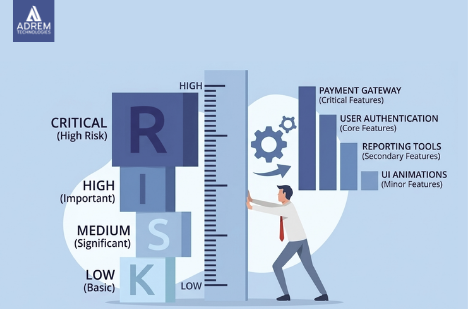
Introduction: When Everything Feels Important, Nothing Truly Is
Open any test dashboard, and you will likely see dozens sometimes hundreds of test cases waiting to be executed.
At first glance, everything appears equally important. However, in reality, not all features carry the same level of risk.
This is exactly where risk-based testing becomes valuable.
Instead of spreading effort evenly, teams begin focusing on what truly matters. As a result, testing becomes more strategic, efficient, and aligned with business priorities.
Risk Levels vs Testing Priority
| Risk Level | Business Impact | Testing Priority |
|---|---|---|
| High | Revenue loss, system failure | Immediate and thorough |
| Medium | Partial disruption | Moderate focus |
| Low | Minor inconvenience | Minimal testing |
What Is Risk-Based Testing?
Risk-based testing is a structured approach that prioritizes testing efforts based on two key factors:
-
Impact of failure
-
Likelihood of occurrence
In other words, instead of testing everything equally, teams focus first on areas that could cause the most damage.
Key Characteristics:
-
Aligns QA efforts with business goals
-
Prioritizes high-impact features
-
Optimizes time and resources
-
Supports faster decision-making
-
Improves release confidence
Ultimately, it shifts testing from activity-based to impact-driven.
Why Traditional Testing Falls Short
Many teams still rely on checklist-driven testing. While this approach ensures coverage, it often lacks prioritization.
As a result:
-
Time is wasted on low-risk features
-
Critical defects may remain undetected
-
Testing becomes reactive instead of strategic
For example, spending hours testing UI color changes while overlooking payment processing logic can lead to serious production issues.
Therefore, prioritization is not optional it is essential.
Key Factors That Define Risk in QA
To apply risk-based testing effectively, teams must evaluate risk across multiple dimensions.
1. Business Impact
-
Does this feature affect revenue?
-
Will failure impact customer trust?
2. Likelihood of Failure
-
Is the code complex?
-
Has it changed frequently?
3. User Exposure
-
How many users rely on it?
-
Is it customer-facing?
4. Technical Complexity
-
Does it involve integrations?
-
Are third-party systems involved?
Risk Assessment Matrix Example
| Feature | Impact Score | Likelihood Score | Risk Level |
|---|---|---|---|
| Payment Gateway | 10 | 8 | High |
| Login System | 9 | 7 | High |
| Profile Settings | 6 | 5 | Medium |
| Theme Customization | 2 | 3 | Low |
How to Implement Risk-Based Testing
Transitioning to risk-based testing does not require a complete overhaul. Instead, follow a structured approach:

-
Identify critical business features
-
Collaborate with stakeholders
-
Assign risk scores (impact × likelihood)
-
Prioritize test cases accordingly
-
Focus on high-risk areas first
-
Continuously update risk assessments
-
Adapt to changing requirements
By following these steps, teams can gradually build a more intelligent testing strategy.
Applying Risk-Based Testing in Real Workflows
In practice, the approach becomes straightforward:
-
Start with high-risk features such as payments and authentication
-
Test edge cases thoroughly
-
Then move to medium-risk areas
-
Finally, validate low-risk features with minimal effort
Additionally:
-
Use automation for repetitive tasks
-
Reserve manual testing for complex scenarios
This balance improves both speed and accuracy.
Common Mistakes to Avoid
Even experienced teams can misapply risk-based testing.
Watch out for:
-
Over-testing low-risk features
-
Ignoring business impact
-
Relying only on historical data
-
Failing to update risk scores
-
Poor communication between QA and stakeholders
Avoiding these pitfalls ensures consistent results.
Best Practices for Effective Risk-Based Testing
To maximize impact, consider the following:
-
Align testing with business objectives
-
Involve product owners early
-
Use real data to guide decisions
-
Track defect history
-
Keep testing flexible
-
Continuously refine priorities
Consistency and adaptability are key.
Benefits of Risk-Based Testing
| Benefit | Outcome |
|---|---|
| Better Focus | Efficient resource allocation |
| Faster Releases | Reduced testing time |
| Improved Quality | Fewer critical defects |
| Cost Savings | Lower maintenance costs |
How Risk-Based Testing Transforms Teams
Interestingly, this approach does more than improve testing it changes how teams work.
-
QA and business teams collaborate more closely
-
Developers become aware of critical risks
-
Testers focus on impact rather than volume
-
Decision-making becomes faster and clearer
Over time, this creates a more aligned and efficient development culture.
Balancing Automation with Risk-Based Testing
Automation plays an important role, but it should be applied strategically.
Best Approach:
-
Automate high-risk, high-frequency tests
-
Reduce repetitive manual effort
-
Use manual testing for exploratory scenarios
-
Focus on unpredictable behaviors
This combination ensures both coverage and flexibility.
The Role of Strategic QA Thinking
Organizations increasingly recognize that testing is not about quantity it is about quality.
Companies like Adrem Technologies emphasize that smarter prioritization leads to better outcomes than simply increasing test volume.
Their approach highlights an important shift: 👉 Testing should guide decisions, not just validate them.
Final Thoughts: Test What Matters Most
Risk-based testing is not about doing less work. Instead, it is about doing the right work.
At first, it may feel uncomfortable to deprioritize certain tests. However, over time, the clarity it brings becomes invaluable.
Next time you review your test cases, pause and ask:
“What would hurt the most if it failed?”
Start there.
Because when risk guides your priorities, testing becomes faster, smarter, and far more effective.
Frequently Asked Questions
What is risk-based testing? It is a testing approach that prioritizes features based on their business impact and likelihood of failure.
Why is risk-based testing important? It helps teams focus on critical areas, improve efficiency, and reduce production risks.
How do you calculate risk in QA? Typically, risk is calculated using impact and likelihood scores.
Can risk-based testing improve release speed? Yes. By focusing on high-priority areas, teams reduce unnecessary testing and accelerate releases.
Is automation required for risk-based testing? Not mandatory, but highly recommended for high-risk and repetitive test cases.
Frequently asked questions
What is risk-based testing?
It is a testing approach that prioritizes features based on their business impact and likelihood of failure.
Why is risk-based testing important?
It helps teams focus on critical areas, improve efficiency, and reduce production risks.
How do you calculate risk in QA?
Typically, risk is calculated using impact and likelihood scores.
Can risk-based testing improve release speed?
Yes. By focusing on high-priority areas, teams reduce unnecessary testing and accelerate releases.
Is automation required for risk-based testing?
Not mandatory, but highly recommended for high-risk and repetitive test cases.
Tags
Author

Sara Adam