
Future of Retail and Supply Chain in the UAE with Microsoft Dynamics 365 (2026 Outlook)
Introduction: A Market That Moves Fast
Retail in the UAE carries a distinctive energy.
Walk through a busy shopping district in Dubai or browse an online store late at night, and the pace is clear. Expectations are high. Patience is limited.
Behind polished storefronts and fast delivery promises, however, a deeper shift is underway. Retail and supply chain operations across the country are being rebuilt quietly. Not overnight. Not dramatically. Instead, the change is steady and deliberate.
At the centre of this transition are organisations like Adrem Technologies, working with companies in the UAE that want operations to feel less fragmented and more dependable. The focus remains practical: clearer inventory, faster responses, and fewer small errors that grow into daily frustration.
Looking toward 2026, the future of retail and supply chain in the UAE appears less about chasing trends and more about regaining control. Platforms such as Microsoft Dynamics 365 are becoming part of that conversation in a very real way.
Retail and Supply Chain Evolution in the UAE
| Area | Traditional Approach | Direction by 2026 |
|---|---|---|
| Inventory tracking | Manual reconciliation | Real-time system visibility |
| Demand planning | Historical sales data | Predictive planning models |
| Supplier coordination | Emails and calls | Integrated digital workflows |
| Retail operations | Store-focused | Omnichannel-focused |
| Decision-making | Delayed reporting | Live operational insights |
Retail in the UAE Is Accelerating, Not Slowing
Out of curiosity, observe how shopping behaviour has changed in recent years.
Customers compare prices faster. They expect accurate delivery windows. They notice immediately when store availability does not match online listings.
This shift is not impatience. Rather, it is familiarity.
The UAE has grown used to efficiency. Therefore, when something feels slow or unclear, it stands out quickly. Retailers experience this pressure daily, and so do distributors and suppliers.
A delayed shipment or a late report rarely causes alarm at first. Over time, however, these small gaps quietly erode trust. By 2026, tolerance for that erosion will likely be even lower.
Supply Chains Are Becoming Conversations, Not Checklists
Supply chains were once linear.
Order. Ship. Receive. Sell.
That simplicity no longer holds. Today, returns, split deliveries, online channels, regional warehouses, and cross-border suppliers intersect constantly. Each step depends on timely information from the last.
When updates arrive late, decisions suffer. For that reason, connected systems matter not because they sound impressive, but because they reduce hesitation and second-guessing.
Where Microsoft Dynamics 365 Fits
Microsoft Dynamics 365 does not try to impress with complexity. Instead, its strength lies in consistency.
By bringing finance, inventory, logistics, and customer data into one environment, changes in one area reflect immediately elsewhere. Numbers update automatically. Teams stop debating which report is correct.
For supply chain management in the UAE, this reliability is critical. The region moves too fast for delayed or conflicting information.
Interestingly, many organisations assume problems come from people. In reality, systems often fail simply because they are not speaking to one another. Dynamics 365 helps resolve that silence.
Retail Operations by 2026 May Feel Calmer
Retail will always be busy. However, calm operations do not mean less demand.
Instead, calm means fewer surprises.
Stock levels make sense. Online and physical channels agree. Staff spend less time apologising and more time helping customers.
Several retail leaders in the UAE have shared that once connected platforms were introduced, urgent fixes dropped noticeably. As a result, workdays became more predictable.
Predictability in retail is often underestimated.
What Still Keeps Leaders Awake at Night
Of course, no system removes uncertainty.
Shipping routes change. Suppliers miss deadlines. Costs fluctuate.
The difference lies in visibility.
When delays surface early, options exist. Businesses can reroute stock, adjust promotions, or communicate clearly with customers. Without visibility, responses arrive too late.
Therefore, the real value of platforms like Dynamics 365 is not problem prevention. It is problem manageability.
How UAE Companies Use Dynamics 365 Across Operations
Retailers, distributors, and manufacturers all use Dynamics 365 differently. Nevertheless, one element connects every use case: shared data.
When procurement, warehousing, sales, and finance operate from the same information, internal friction drops. Meetings shorten. Decisions feel grounded rather than rushed.
| Business Area | Practical Application |
|---|---|
| Procurement | Supplier performance tracking |
| Warehousing | Accurate stock location visibility |
| Distribution | Delivery planning and monitoring |
| Finance | Cost visibility and margin control |
| Customer service | Real-time order status |
Across all areas, one benefit remains consistent. Shared data reduces internal tension.
Adrem Technologies’ Approach to Real-World Implementation
Technology alone rarely fixes issues.
For that reason, Adrem Technologies approaches Microsoft Dynamics 365 implementations in the UAE with close attention to how people actually work. Not how diagrams suggest they should.
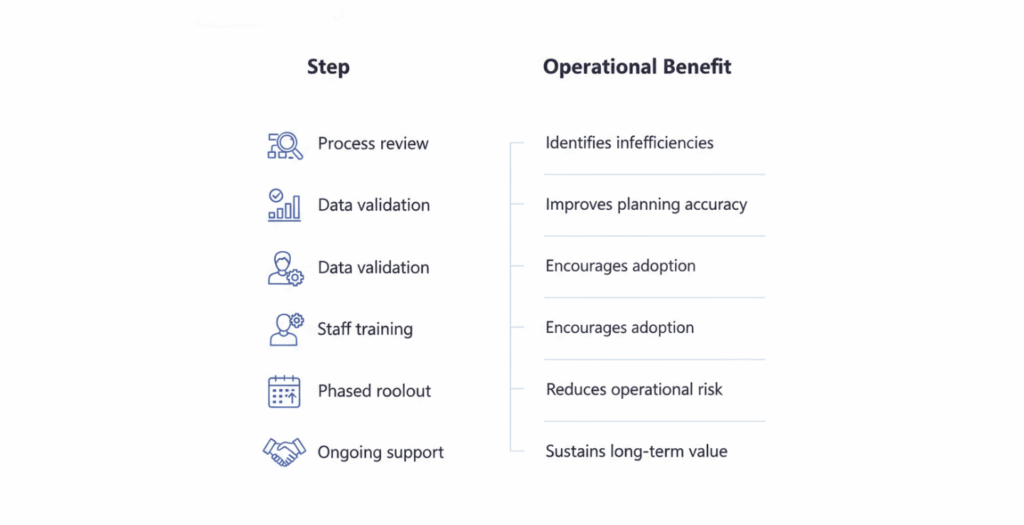
Processes are reviewed carefully. Data is prepared before migration. Training respects daily routines rather than disrupting them.
Because of this patience, systems settle more smoothly. Trust grows gradually. Many failed projects did not fail due to software, but because adoption was rushed.
Retail Digital Transformation Without the Noise
The phrase “digital transformation” is often overused.
In practice, transformation usually looks simpler:
-
Fewer spreadsheets
-
Less rework
-
Clearer numbers
In the UAE, retail transformation tends to happen in layers. One system connects. Then another. Confidence builds.
It rarely feels dramatic. More often, it feels relieving.
Security, Trust, and Responsibility
Retail systems handle sensitive data.
Customer details. Payment information. Supplier contracts.
Microsoft’s cloud infrastructure supports regional compliance requirements, which reassures companies in the UAE navigating strict expectations. Still, security is not only technical.
Clear access rules, training, and awareness matter just as much. Over time, trust grows when systems behave consistently.
Signals from the Market
Recent regional business reports highlight continued investment in logistics hubs, cloud platforms, and trade initiatives.
Retailers who adopted connected systems early appear better prepared for seasonal demand spikes. Stockouts declined. Delivery commitments became more reliable.
These outcomes rarely make headlines. Yet operationally, they matter.
Preparing for 2026 Without Overcomplicating It
Preparation does not require a dramatic overhaul.
Often, it starts with honest questions:
-
Where does information stall?
-
Which reports arrive too late?
-
Where do teams rely on daily workarounds?
Once these answers surface, next steps become clearer.
Common Misunderstandings Still Exist
Some believe Dynamics 365 suits only large enterprises. Others fear complexity.
In reality, scale depends on design. Simplicity depends on discipline.
Another assumption suggests automation removes control. In contrast, it shifts control closer to real time. That distinction matters.
Conclusion: A Grounded Outlook for 2026
The future of retail and supply chain in the UAE appears less about disruption and more about maturity.
Businesses want systems that behave predictably. They want information that arrives on time. They want decisions that feel informed, not rushed.
Microsoft Dynamics 365 fits into this future as a steady foundation rather than a flashy solution. Adrem Technologies supports this journey by working closely with companies in the UAE to build operations that remain reliable under pressure.
As 2026 approaches, reliability may prove more valuable than any bold prediction.
Progress rarely announces itself. Sometimes, it simply makes the day run smoother.
Is Microsoft Dynamics 365 suitable for retail businesses in the UAE? Yes. The platform adapts to different retail sizes and supports connected sales, inventory, and supply chain operations.
How does Dynamics 365 support UAE supply chains? It provides real-time visibility into inventory, supplier performance, and logistics activity, enabling earlier and more confident decisions.
What role does Adrem Technologies play in implementation? They align the platform with real workflows, supporting adoption, training, and long-term system stability.
Does Dynamics 365 support both online and physical retail? Yes. Omnichannel visibility is a core strength of the platform.
Do staff need advanced technical skills? No. Interfaces are designed for everyday use and supported through structured training.
Frequently asked questions
Is Microsoft Dynamics 365 suitable for retail businesses in the UAE?
Yes. The platform adapts to different retail sizes and supports connected sales, inventory, and supply chain operations.
How does Dynamics 365 support UAE supply chains?
It provides real-time visibility into inventory, supplier performance, and logistics activity, enabling earlier and more confident decisions.
What role does Adrem Technologies play in implementation?
They align the platform with real workflows, supporting adoption, training, and long-term system stability.
Does Dynamics 365 support both online and physical retail?
Yes. Omnichannel visibility is a core strength of the platform.
Do staff need advanced technical skills?
No. Interfaces are designed for everyday use and supported through structured training.
Tags
Author

Sara Adam