
Creating a Single Source of Truth with Microsoft Dynamics 365 Integration
Introduction: When Every Department Has a Different Number
It is surprisingly common for meetings to begin with confusion around something as basic as revenue. The finance team presents one figure from the accounting system. The sales team shows another number from the CRM. Meanwhile, operations quietly mention that their reports tell a slightly different story.
So which number should leadership trust?
Situations like this appear more often than organisations admit. They reveal a deeper structural issue: business data lives in multiple disconnected systems, each telling its own version of the truth. When information is scattered across platforms, decisions slow down and departments struggle to stay aligned.
This is exactly why creating a single source of truth with Microsoft Dynamics 365 integration has become such an important topic for modern organisations. Businesses are beginning to realise that data consistency is not just a technical improvement. It is essential for operational clarity and confident decision-making.
Today, companies rely on multiple tools to run their operations. Sales teams depend on CRM platforms, finance teams manage accounting systems, operations teams track inventory through specialized tools, and leadership expects accurate reports based on all these sources.
When these systems operate independently, employees spend hours verifying spreadsheets and reconciling numbers before making decisions. A single source of truth eliminates this complexity by ensuring that every department works with consistent and reliable data.
Organisations focusing on enterprise integration increasingly address this challenge. Companies such as Adrem Technologies help businesses connect enterprise systems so that data flows smoothly between platforms rather than remaining trapped in isolated applications.
Their work highlights a key insight: technology alone does not improve operations unless those technologies communicate effectively with each other.
Common Data Challenges Before Integration
| Department | Typical Data Issue | Operational Impact |
|---|---|---|
| Sales | CRM data separate from inventory system | Incorrect order commitments |
| Finance | Accounting system not connected with sales platform | Delayed revenue reporting |
| Operations | Inventory data stored in isolated software | Limited stock visibility |
| Customer Support | No unified customer profiles | Slower response times |
| Leadership | Reports compiled manually | Uncertain decision-making |
Understanding the Concept of a Single Source of Truth
The phrase “single source of truth” appears frequently in discussions about enterprise technology, yet its meaning is often misunderstood.
Some assume it means storing all data in a single database. Others believe it requires replacing every existing system with one platform.
In reality, neither of these assumptions fully explains the concept.
A single source of truth refers to an environment where all systems synchronize data so that every department accesses consistent, reliable, and up-to-date information.
Think of it as a shared language inside an organisation. Finance, sales, and operations might use different software tools, but the underlying data remains consistent because those tools exchange information automatically.
Without this alignment, organisations operate with fragmented insights. With it, they gain clarity.
Why Data Fragmentation Hurts Business Performance
Fragmented data often affects daily operations more deeply than leaders initially realise.
The problem rarely appears dramatic at first. Instead, it begins with small inconsistencies.
For example:
-
A sales representative notices that a customer address differs between the CRM and billing system
-
An operations manager sees inventory numbers that do not match warehouse records
-
Finance teams spend additional hours reconciling figures before closing monthly reports
Individually, these issues seem manageable. However, when they occur repeatedly across departments, the cost grows significantly.
Productivity Loss
Employees spend time verifying data rather than focusing on strategic work.
Slower Decision-Making
Leaders hesitate when reports contain conflicting information.
Customer Experience Issues
Support teams cannot view complete customer histories across systems.
Compliance Risks
Inconsistent data may create regulatory complications.
Over time, these inefficiencies reduce an organisation’s ability to move quickly and confidently.
How Microsoft Dynamics 365 Enables a Unified Data Environment
This is where platforms like Microsoft Dynamics 365 become valuable.
Dynamics 365 offers an integrated ecosystem of business applications designed to support:
-
Sales
-
Finance
-
Customer service
-
Operations
-
Analytics
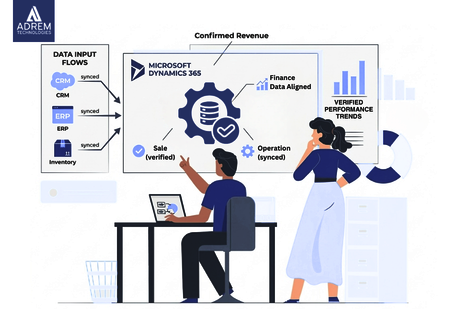
However, its true strength appears when integration connects Dynamics 365 with other enterprise systems.
For example:
-
CRM modules can synchronize with accounting platforms
-
Sales transactions automatically update inventory levels
-
Customer interactions flow into service management systems
Instead of operating as separate tools, these applications become part of a coordinated data network.
That network forms the foundation of a single source of truth.
Data Flow Before and After Integration
| Process Stage | Before Integration | After Integration |
|---|---|---|
| Customer order entry | Recorded only in CRM | Automatically shared with finance and inventory |
| Inventory updates | Updated in warehouse software only | Sync instantly with sales dashboards |
| Financial reporting | Manual spreadsheet consolidation | Automated reporting |
| Customer support | Limited purchase visibility | Complete customer history available |
Business Functions That Benefit Most from Integration
While integration improves the entire organisation, several departments experience immediate benefits.

Sales and Customer Management
Sales teams gain instant visibility into inventory levels, order status, and customer purchase history.
Financial Operations
Accounting teams receive synchronized transaction data, making reconciliation and reporting significantly easier.
Supply Chain Management
Inventory visibility improves across warehouses, suppliers, and distribution channels.
Customer Support
Service representatives can access complete customer profiles that include purchases, billing history, and previous support interactions.
These improvements help departments collaborate more effectively.
Strategic Advantages of a Single Source of Truth
| Business Area | Benefit |
|---|---|
| Decision-making | Leaders rely on consistent reports |
| Operational efficiency | Reduced manual data processing |
| Customer experience | Faster, more informed service |
| Data accuracy | Less duplication and fewer errors |
| Strategic planning | Reliable analytics for long-term strategy |
Integration and the Future of Enterprise Data
Technology continues to evolve rapidly, yet one principle remains constant.
Data becomes valuable only when organisations trust it.
A single source of truth creates that trust.
As businesses adopt cloud platforms, analytics systems, and artificial intelligence, integrated data environments become even more important. These advanced technologies rely heavily on consistent data to generate meaningful insights.
Without integration, advanced analytics tools struggle to produce reliable results.
With integration, organisations unlock deeper operational intelligence.
Final Thoughts
Modern organisations generate data from many sources: sales systems, financial platforms, operational tools, and customer service applications. Each system captures valuable information, but that information becomes powerful only when it connects with other systems.
The concept of creating a single source of truth with Microsoft Dynamics 365 integration addresses this challenge by enabling data to move seamlessly across the organisation.
When systems communicate effectively, employees stop questioning which report is accurate. Instead, they focus on solving real business problems.
Integration also transforms the pace of business operations. Leaders no longer wait for manually compiled reports or spend time reconciling spreadsheets. Instead, they gain access to reliable insights in real time.
Departments collaborate more easily because everyone relies on the same operational data. Over time, this shift improves decision-making, customer responsiveness, and overall organisational performance.
Companies such as Adrem Technologies play an important role in helping organisations build integrated digital environments where enterprise systems work together. Their experience demonstrates a valuable lesson for modern businesses:
Technology delivers its greatest value not when systems operate independently, but when they work together to create a consistent and trustworthy foundation for business intelligence.
Frequently Asked Questions
What is a single source of truth in business systems? A single source of truth is a data environment where all systems share synchronized information, ensuring that every department works with consistent and accurate data.
Why do companies struggle with fragmented data? Fragmented data occurs when different business systems operate independently without integration, causing inconsistent reports and slower decision-making.
How does Microsoft Dynamics 365 help create a unified data environment? Microsoft Dynamics 365 connects business processes such as sales, finance, operations, and customer service into an integrated ecosystem where data flows automatically across departments.
Why is system integration important for enterprise data management? Integration ensures that business systems exchange information automatically, reducing manual data entry, improving accuracy, and enabling real-time reporting.
How can Adrem Technologies help organizations implement integration? Adrem Technologies helps businesses connect enterprise applications and implement Microsoft Dynamics 365 solutions that unify data across departments and create a reliable single source of truth.
Frequently asked questions
What is a single source of truth in business systems?
A single source of truth is a data environment where all systems share synchronized information, ensuring that every department works with consistent and accurate data.
Why do companies struggle with fragmented data?
Fragmented data occurs when different business systems operate independently without integration, causing inconsistent reports and slower decision-making.
How does Microsoft Dynamics 365 help create a unified data environment?
Microsoft Dynamics 365 connects business processes such as sales, finance, operations, and customer service into an integrated ecosystem where data flows automatically across departments.
Why is system integration important for enterprise data management?
Integration ensures that business systems exchange information automatically, reducing manual data entry, improving accuracy, and enabling real-time reporting.
How can Adrem Technologies help organizations implement integration?
Adrem Technologies helps businesses connect enterprise applications and implement Microsoft Dynamics 365 solutions that unify data across departments and create a reliable single source of truth.
Tags
Author

Sara Adam