

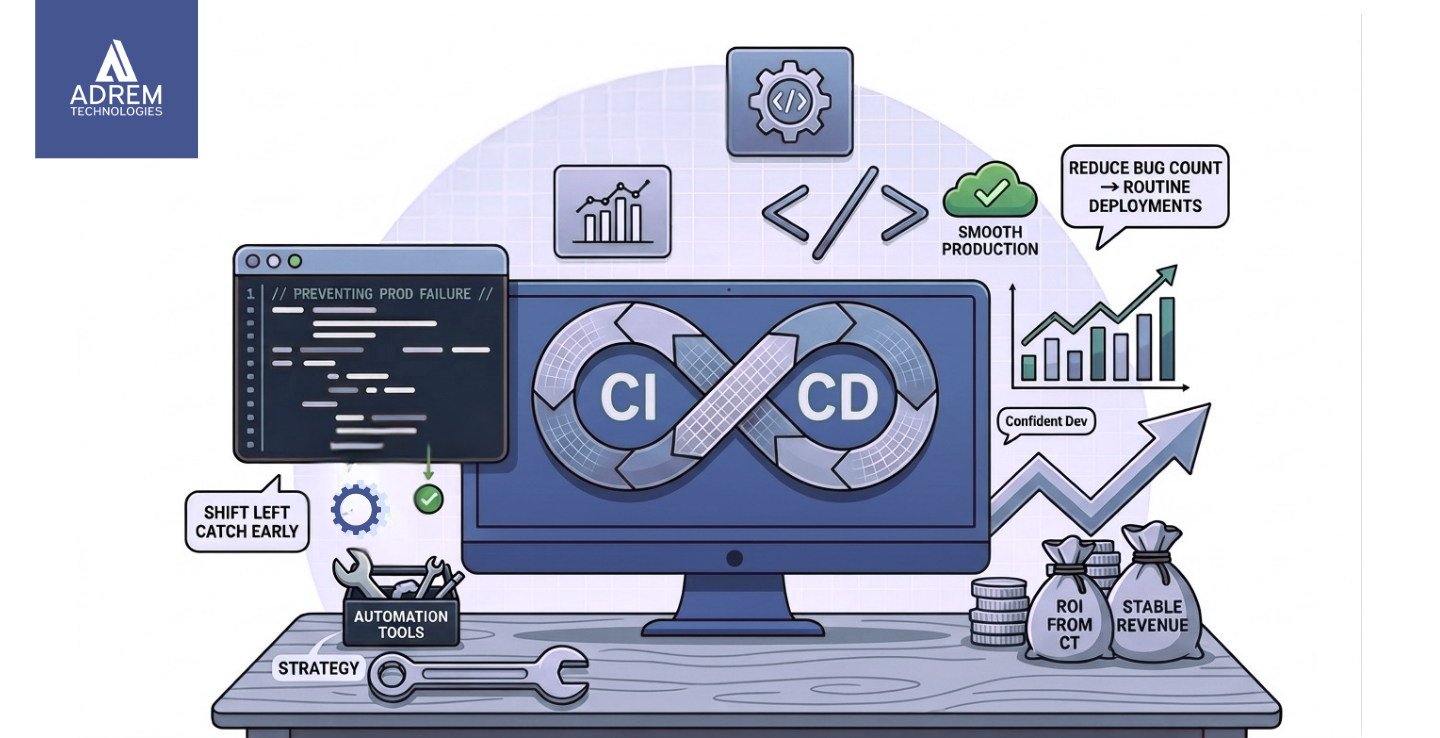
Introduction: When Speed Meets Risk
You push code with confidence. A few minutes later, something unexpected breaks.
Sound familiar?
This situation happens more often than teams admit. Modern development moves quickly, and while speed is valuable, it also increases risk. Without a structured testing approach inside your pipeline, even small changes can create larger problems.
That is exactly why continuous testing in CI/CD pipelines is no longer optional.
Instead of treating testing as a final step, it becomes part of every stage of development. Each commit, merge, and deployment carries its own safety net.
CI/CD Pipeline Stages and Testing Types
| Pipeline Stage | Testing Type | Purpose |
|---|---|---|
| Code Commit | Unit Testing | Validate individual components |
| Build Phase | Integration Testing | Ensure modules work together |
| Pre-Deployment | System Testing | Verify complete functionality |
| Post-Deployment | Monitoring & Feedback | Detect real-world issues |
What Is Continuous Testing in CI/CD Pipelines?
At its core, continuous testing means running automated tests throughout the entire CI/CD pipeline.
Rather than waiting until development ends, testing happens continuously.
Key characteristics include:
- Automated tests triggered at every stage
- Immediate feedback for developers
- Reduced risk of production defects
- Seamless integration with tools like Jenkins, GitHub Actions, and GitLab CI
As a result, teams release faster while maintaining stability.
Why Continuous Testing Matters More Than Ever
Software delivery cycles are shrinking. Meanwhile, user expectations are rising.
Because of this shift:
- Even minor bugs can impact revenue
- Poor performance can damage user trust
- Delayed fixes increase operational costs
For example, imagine deploying a payment feature that fails during peak traffic. The impact is immediate and costly.
However, with continuous testing:
- Issues are detected early
- Fixes happen before deployment
- Confidence in releases improves
Ultimately, teams spend less time firefighting and more time innovating.
Core Components of a Strong CI/CD Testing Strategy
To implement continuous testing effectively, several elements must work together:

- Automated test suites that run consistently
- Integration with version control systems
- Test environments that mirror production
- Clear reporting and feedback systems
- Performance and security testing tools
- Continuous monitoring after deployment
Together, these components create a reliable and scalable testing framework.
Types of Tests You Should Include
A well-balanced testing strategy includes multiple layers.
Unit Tests
- Focus on small code components
- Run quickly and frequently
- Catch issues early in development
Integration Tests
- Validate interactions between modules
- Ensure APIs and services communicate correctly
End-to-End Tests
- Simulate real user behaviour
- Verify complete workflows
Performance Tests
- Measure system response under load
- Identify bottlenecks before users do
Security Tests
- Detect vulnerabilities early
- Protect sensitive data
Testing Tools Comparison
| Tool | Best For | Key Advantage |
|---|---|---|
| Selenium | UI Testing | Cross-browser support |
| JUnit | Unit Testing | Lightweight and fast |
| TestNG | Integration Testing | Flexible configuration |
| JMeter | Performance Testing | Load simulation capabilities |
How to Implement Continuous Testing Step by Step
Getting started does not require a complete overhaul.
Instead, follow a gradual approach:
- Begin with unit tests
- Add integration and system tests progressively
- Automate execution within your pipeline
- Trigger tests on every commit
- Create isolated test environments
- Maintain consistency across environments
- Monitor results continuously
- Fix issues immediately
Over time, this structured approach builds a strong testing culture.
Real-World Scenario: Catching Issues Before They Reach Users
Consider an e-commerce platform.
A developer updates the checkout process.
Without continuous testing:
- The issue goes unnoticed
- Customers cannot complete purchases
- Revenue drops instantly
With continuous testing:
- A failing test flags the issue immediately
- The developer fixes it before deployment
- Customers never experience the problem
That difference is critical.
Common Challenges and How to Overcome Them
Even with automation, teams may face obstacles.
Common Issues
- Flaky tests that fail unpredictably
- Slow execution times
- Incomplete test coverage
Practical Solutions
- Stabilise test environments
- Optimise test scripts
- Prioritise high-impact test cases
Addressing these challenges improves reliability and efficiency.
Best Practices for Continuous Testing
To maximise results, follow these guidelines:
- Keep tests fast and reliable
- Focus on critical business workflows
- Use parallel testing to reduce execution time
- Update test cases regularly
- Integrate security testing early
- Maintain clear documentation
Consistency is key.
Benefits of Continuous Testing
| Benefit | Impact |
|---|---|
| Faster Releases | Reduced time to market |
| Improved Quality | Fewer production bugs |
| Better Collaboration | Stronger team alignment |
| Cost Efficiency | Lower bug-fixing costs |
The Role of Modern Engineering Practices
Organizations increasingly rely on structured approaches to improve development workflows.
Companies like Adrem Technologies highlight how combining automation, strategy, and discipline transforms software delivery.
Their work reinforces an important idea:
Testing should not be a final checkpoint. It should be continuous.
Final Thoughts: From Reactive to Proactive Quality
Continuous testing changes how teams think about software quality.
Instead of reacting to issues after deployment, teams begin preventing them early.
At first, the shift may feel challenging. However, the long-term benefits are clear:
- Fewer production issues
- More predictable releases
- Greater confidence in deployments
If you are starting this journey, keep it simple:
- Begin with one layer of automation
- Observe the impact
- Expand gradually
Over time, you will notice fewer surprises and far fewer late-night fixes.
Frequently Asked Questions
It is the practice of running automated tests at every stage of the development pipeline to ensure consistent code quality.
It helps detect issues early, improves software quality, and enables faster, safer releases.
Popular tools include Selenium, JUnit, TestNG, and JMeter.
Yes. Even small teams can start with basic unit tests and gradually expand their testing strategy.
By identifying issues early, it ensures that only stable and reliable code reaches production.
