

Introduction
Many companies invest in modern software platforms expecting immediate improvements in efficiency, reporting, and decision-making. Yet despite using advanced tools, some organizations still struggle with slow processes, data confusion, and operational delays.
The issue often does not lie in employee productivity or poor management. Instead, the problem hides deeper within the organization’s technology structure.
Disconnected business systems quietly affect collaboration, reporting accuracy, and operational performance across departments. When accounting software, inventory systems, CRM platforms, and reporting tools operate independently rather than communicating with one another, teams spend more time managing data than running the business.
Consider a typical workday in many organizations. The finance team exports spreadsheets from accounting systems, while operations manually enter similar data into another platform. Meanwhile, the sales team relies on a CRM that is not connected to inventory or billing systems.
The result is predictable:
- Duplicate work
- Delayed decisions
- Conflicting reports
- Growing frustration among employees
This is why understanding the hidden cost of disconnected business systems has become an important conversation for modern organizations. Integration transforms fragmented systems into a connected digital ecosystem where information flows automatically.
Companies such as Adrem Technologies help organizations address these challenges by integrating enterprise systems so departments can share real-time data rather than relying on manual updates and outdated reports.
Technology alone cannot improve operations unless those technologies communicate with each other.
Common Signs of Disconnected Business Systems
Disconnected systems create operational friction across departments.
Signs of Disconnected Systems
| Operational Area | Typical Problem | Business Impact |
|---|---|---|
| Finance | Data manually exported between systems | Delayed financial reporting |
| Sales | CRM disconnected from inventory | Incorrect product availability |
| Operations | Separate asset tracking tools | Equipment misplacement |
| Customer Service | No shared customer records | Slow issue resolution |
| Management Reporting | Multiple spreadsheets required | Poor decision-making |
These issues may appear small individually, but together they create significant inefficiencies.
What Disconnected Systems Actually Mean
Many organizations assume disconnected systems simply mean using multiple software platforms. In reality, the real problem arises when these platforms cannot exchange information automatically.
Disconnected systems occur when applications operate in isolation. For example:
- A finance system stores transaction data
- A supply chain platform manages inventory
- A CRM tracks customer interactions
Yet none of these systems communicate directly.
Employees become the unofficial integration layer. They export reports, copy data into spreadsheets, upload files, and email updates between departments.
While this approach may work in early stages of growth, complexity increases rapidly as organizations expand.
Over time:
- Information becomes fragmented
- Reports contradict each other
- Decision-making slows down
- Hidden operational costs accumulate
The Hidden Operational Costs
Most companies evaluate technology investments based on licensing costs. However, the largest expenses associated with disconnected systems rarely appear on invoices.
Instead, they appear in daily operations.
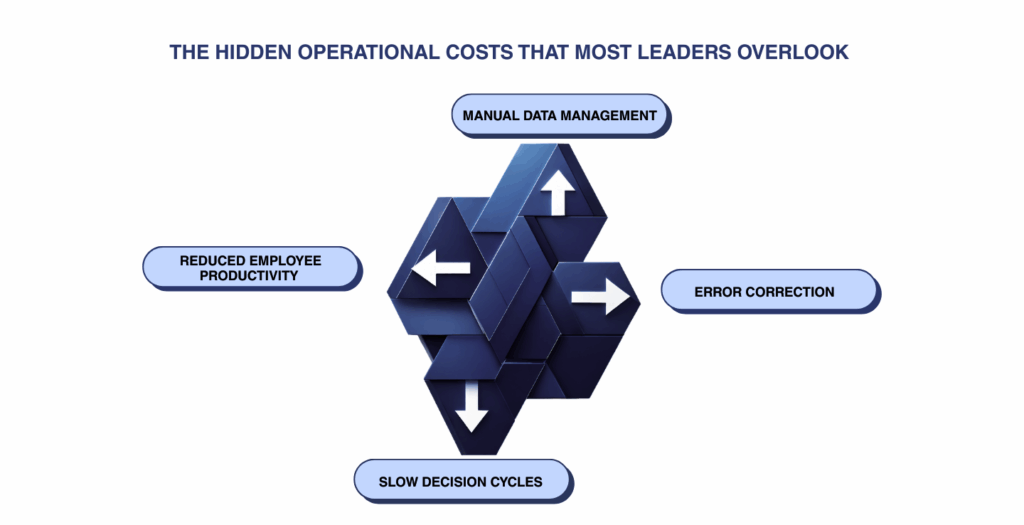
Manual Data Management
Employees often spend hours transferring data between systems. For instance, a finance analyst may spend half a day reconciling numbers from several databases.
This time could otherwise be dedicated to strategic analysis.
Error Correction
Manual data entry increases the likelihood of errors. A single incorrect number can spread across multiple reports, requiring additional verification and corrections.
Slow Decision Cycles
When executives need accurate reports, teams must gather information from multiple departments. By the time reports are finalized, the opportunity to act may already be gone.
Reduced Employee Productivity
Highly skilled professionals rarely enjoy repetitive administrative tasks. Over time, frustration increases and productivity decreases.
Estimated Productivity Loss
| Department | Time Lost Weekly | Cause |
|---|---|---|
| Finance | 6 hours | Data reconciliation |
| Sales | 4 hours | Checking inventory availability |
| Operations | 5 hours | Manual asset tracking |
| Customer Support | 3 hours | Searching for customer history |
| Management | 4 hours | Compiling reports |
These hours represent hidden operational costs that many organizations overlook.
Why Integration Changes Everything
Enterprise system integration connects business applications so they can exchange information automatically.
Instead of employees transferring data manually, systems communicate directly.
For example:
- Inventory updates instantly appear in the sales system
- Customer information flows from CRM to billing platforms
- Asset records synchronize with maintenance systems
As a result, information becomes consistent across departments.
This shift significantly improves collaboration and operational efficiency.
How Integration Improves Cross-Department Collaboration
Disconnected systems create invisible barriers between departments. Integration removes those barriers by enabling shared access to real-time information.
Shared Data Visibility
Departments work from the same data sources instead of maintaining separate records.
Faster Communication
Teams no longer need to request updates repeatedly because systems synchronize automatically.
Coordinated Decision Making
Managers analyze unified data instead of comparing multiple reports from different departments.
In practical terms, finance, operations, and sales can finally operate from the same operational reality.
Strategic Advantages of Integrated Systems
Integration does more than reduce operational friction. It also enables strategic improvements that disconnected systems cannot support.
Real-Time Analytics
Integrated systems allow organizations to access live business insights.
Predictive Decision-Making
Unified data supports forecasting models that identify demand trends and operational risks.
Improved Customer Experience
Customer service teams can instantly access purchase history, order status, and support interactions.
This level of responsiveness strengthens customer relationships.
Disconnected vs Integrated Systems
| Factor | Disconnected Systems | Integrated Systems |
|---|---|---|
| Data Accuracy | Frequent inconsistencies | Reliable unified data |
| Reporting | Manual compilation | Automated real-time reporting |
| Collaboration | Department silos | Cross-department visibility |
| Productivity | Repetitive tasks | Focus on strategic work |
| Customer Service | Delayed responses | Faster issue resolution |
Technology Integration in Modern Enterprises
Today, integration forms the backbone of digital transformation.
Modern integration technologies include:
- APIs that allow applications to communicate
- Middleware platforms connecting systems
- Cloud integration services synchronizing data
These solutions allow companies to connect systems without replacing existing software.
Instead of discarding current tools, organizations build digital bridges between them. This protects earlier investments while unlocking operational efficiency.
Business Areas That Benefit Most from Integration
Although every department benefits from system integration, some areas experience immediate improvements.
Financial Management
Automated synchronization ensures accurate reporting and faster financial closing cycles.
Supply Chain Operations
Inventory updates and order management synchronize across systems.
Asset Management
Integrated platforms provide better visibility into equipment and infrastructure.
Customer Relationship Management
Sales and support teams gain access to comprehensive customer insights.
Final Thoughts
Disconnected technology systems quietly drain resources from organizations that otherwise appear technologically advanced.
Employees spend hours reconciling data, managers rely on delayed reports, and departments operate without clear visibility into each other’s activities.
These issues rarely receive attention until inefficiencies become too large to ignore.
Enterprise system integration offers a practical solution.
By connecting applications and enabling real-time data exchange, organizations remove barriers that prevent departments from collaborating effectively. Integration improves reporting accuracy, speeds up decision-making, and strengthens coordination across the enterprise.
Companies such as Adrem Technologies demonstrate how thoughtful integration strategies can transform fragmented digital environments into connected ecosystems where information flows freely between departments.
Their work highlights an important lesson for modern businesses:
Technology creates value only when systems communicate effectively.
When enterprise systems are integrated intelligently, organizations gain clearer insights, faster decisions, and stronger collaboration across every level of the business.
Frequently Asked Questions
Disconnected business systems are software platforms that operate independently without sharing data automatically. Examples include CRM, accounting, inventory, and HR systems that require manual data transfers between departments.
When systems are not integrated, employees must manually move data between platforms. This leads to duplicated work, reporting errors, delayed decision-making, and reduced productivity.
Enterprise system integration connects different business applications so they can exchange information automatically. This allows departments to work with the same real-time data across systems such as ERP, CRM, finance, and supply chain platforms.
Integration reduces manual data entry, eliminates duplicate work, and allows employees to access accurate information instantly. As a result, teams spend more time on strategic tasks instead of administrative work.
Adrem Technologies helps businesses design and implement enterprise integration solutions that connect multiple business applications, enabling real-time data sharing, improved reporting, and stronger cross-department collaboration.
