

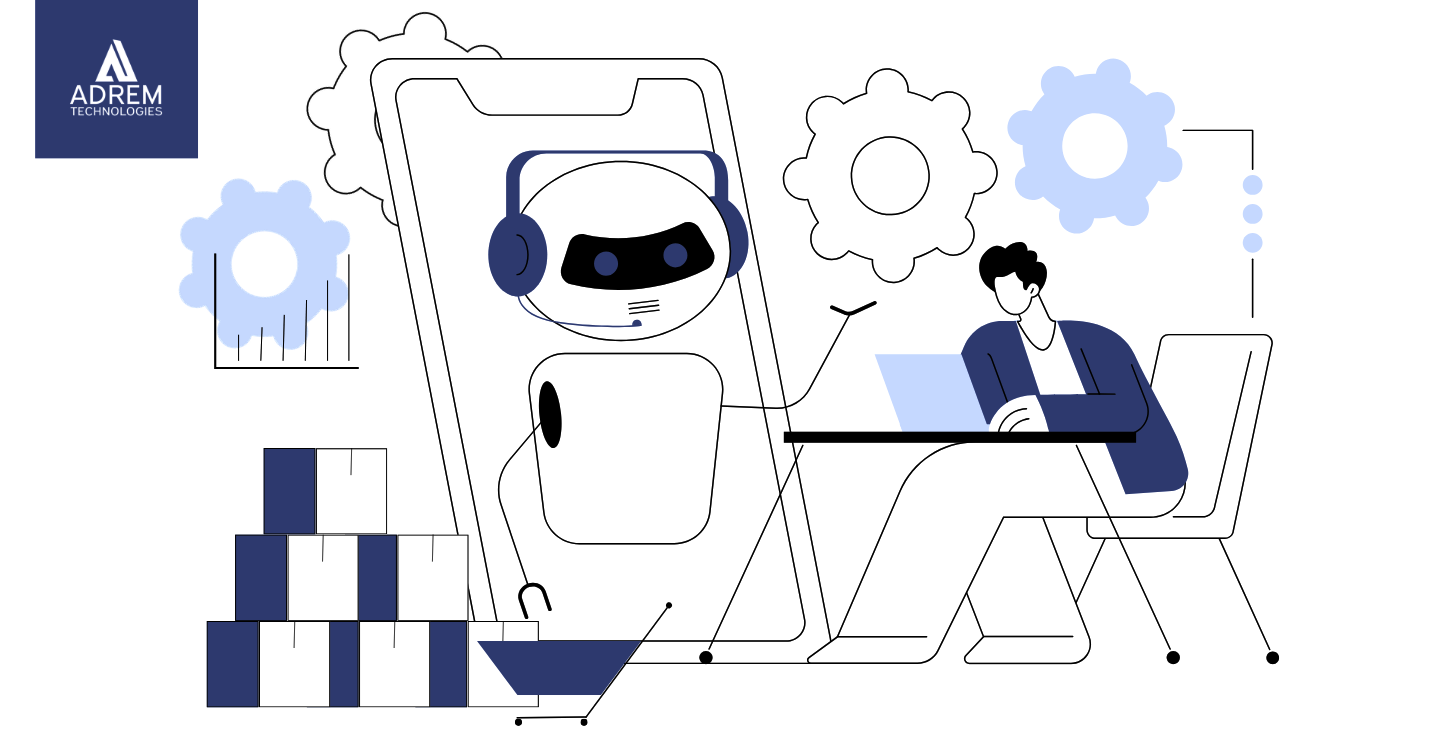
Modern businesses rarely struggle because they lack software. More often, the real challenge lies in how disconnected those systems remain.
Sales teams rely on CRM platforms. Finance and operations depend on ERP systems. Customer support often works inside separate tools altogether. While every department may appear digitally equipped, information still moves slowly between teams. As a result, employees rely on spreadsheets, emails, and quick calls just to confirm routine updates.
This is exactly where AI agents connecting CRM and ERP systems for business automation become valuable.
By creating real-time communication between systems, AI agents reduce delays, improve coordination, and support smoother end-to-end business automation. Companies such as Adrem Technologies continue helping organisations build more connected digital environments through intelligent automation strategies.
In this blog, we will explain:
- How CRM and ERP systems become disconnected
- What AI agents actually do
- How AI improves business automation
- The operational benefits of CRM and ERP integration
- Practical use cases across industries
Why CRM and ERP Systems Often Feel Disconnected
On paper, CRM and ERP systems should work together seamlessly.
A CRM platform manages:
- Customer relationships
- Sales pipelines
- Marketing campaigns
- Customer support history
- Lead tracking
- Account management
Meanwhile, an ERP platform manages:
- Inventory
- Procurement
- Finance
- Supply chain workflows
- Manufacturing operations
- Resource planning
In theory, one system understands customer expectations while the other manages operational execution.
However, in many organisations, these systems function independently.
This creates common business problems such as:
- Sales confirming unavailable stock
- Finance working with outdated order data
- Customer support lacking shipment visibility
- Procurement reacting too late to shortages
- Leadership receiving inconsistent reports
Consequently, operational friction increases.
Traditional Workflows vs AI-Connected Operations
| Business Area | Traditional Workflow | AI-Connected Workflow |
|---|---|---|
| Customer Orders | Manual updates between systems | Real-time synchronization |
| Inventory Management | Delayed stock visibility | Live inventory validation |
| Customer Support | Fragmented customer information | Unified customer context |
| Financial Processing | Manual approvals | Automated workflows |
| Business Reporting | Static reporting cycles | Continuous operational insights |
What AI Agents Actually Do Between CRM and ERP Systems
AI conversations sometimes sound overly technical. In practical business terms, AI agents act like digital operational coordinators.
They monitor multiple systems, identify workflow triggers, and execute tasks automatically.
For example, when a customer places an order:
- The CRM captures the order
- The AI agent checks ERP inventory instantly
- Stock availability gets verified automatically
- Payment conditions are validated
- Procurement receives alerts if stock runs low
- Delivery timelines update immediately
- Customer communication adjusts automatically
Without AI automation, this process may involve multiple departments and repeated manual coordination.
With AI agents, workflows move much faster.
How AI Agents Improve End-to-End Business Automation
AI integration creates practical improvements across business operations.
1. Smarter Order Management
Order coordination improves significantly when CRM and ERP systems communicate automatically.
Businesses can:
- Validate stock instantly
- Detect fulfillment risks early
- Trigger procurement automatically
- Update customers proactively
- Reduce delivery conflicts
As a result, customer satisfaction improves.
2. Faster Financial Coordination
Finance teams often manage hidden operational pressure.
Common finance tasks include:
- Invoice approvals
- Payment validation
- Account reconciliation
- Fraud checks
- Credit monitoring
AI agents help automate these workflows.
Therefore, finance teams spend less time managing repetitive approvals and more time focusing on strategic planning.
3. Better Customer Support Visibility
Customers expect fast, accurate responses.
However, disconnected systems make support unnecessarily difficult.
AI-connected CRM and ERP environments help support teams:
- Access unified customer records
- View order updates instantly
- Check inventory availability
- Review payment status
- Resolve issues faster
Consequently, support teams deliver a stronger customer experience.
Business Functions Improved Through AI Integration
| Business Function | AI Agent Activity | Operational Benefit |
|---|---|---|
| Sales Operations | Real-time order coordination | Better customer communication |
| Finance | Automated invoice matching | Faster cash flow management |
| Customer Support | Unified operational visibility | Faster issue resolution |
| Procurement | Inventory prediction and alerts | Reduced supply shortages |
| Leadership Reporting | Continuous business analysis | Better strategic planning |
Why Employees Often Appreciate AI Automation
Some businesses hesitate when discussing AI automation.
However, employees often appreciate automation once repetitive work decreases.
AI automation helps:
- Sales teams spend more time with customers
- Finance teams reduce reconciliation workloads
- Support teams resolve cases faster
- Operations teams avoid constant status chasing
Instead of replacing valuable employees, AI often removes frustrating administrative tasks.
This improves productivity while reducing operational stress.
AI Improves Inventory Visibility and Supply Chain Coordination
Inventory management often suffers when disconnected systems delay updates.
AI agents improve inventory coordination by:
- Monitoring stock levels continuously
- Triggering low-stock alerts
- Updating sales availability automatically
- Supporting procurement decisions
- Reducing overselling risk
Because inventory visibility improves, operational planning becomes more accurate.
AI Enhances Leadership Decision-Making
Leadership teams need accurate business intelligence.
Unfortunately, disconnected systems often create conflicting reports.
AI integration improves leadership visibility by:
- Consolidating data automatically
- Updating dashboards continuously
- Reducing reporting delays
- Supporting better forecasting
As a result, executives make faster and more confident decisions.
Security and Compliance Still Matter
Business automation must remain secure.
AI-connected CRM and ERP environments should include:
- Data encryption
- Role-based access controls
- Audit visibility
- Compliance monitoring
- Permission management
Especially in finance, healthcare, and regulated industries, governance remains essential.
Automation should improve efficiency without introducing security risk.
Industries Benefiting from AI-Driven CRM and ERP Integration
| Industry | AI Integration Use Case | Business Outcome |
|---|---|---|
| Manufacturing | Production and procurement coordination | Reduced downtime |
| Retail | Real-time inventory management | Improved customer satisfaction |
| Healthcare | Administrative workflow automation | Faster operations |
| Logistics | Predictive shipment planning | Better delivery accuracy |
| Financial Services | Fraud monitoring and compliance automation | Stronger risk control |
The Future of Connected Business Operations
Businesses are steadily moving toward intelligent operational ecosystems.
This shift includes:
- Predictive procurement workflows
- Automated customer communication
- AI-assisted financial forecasting
- Real-time inventory optimization
- Continuous business process automation
Not every organisation will move at the same speed.
However, customer expectations continue rising.
Because of that, disconnected systems are becoming increasingly difficult to justify.
Common Challenges When Implementing AI Integration
AI integration offers strong benefits, but businesses should plan carefully.
Common challenges include:
- Legacy system compatibility
- Data inconsistency
- Weak process documentation
- Limited internal AI readiness
- Security governance concerns
Therefore, businesses should approach AI integration strategically rather than rushing implementation.
Why Businesses Work with Integration Partners
Connecting CRM and ERP systems requires both technical and operational expertise.
Businesses often work with specialists because successful integration depends on:
- Workflow understanding
- System architecture planning
- Security controls
- Data governance
- Business process alignment
Adrem Technologies continues supporting organisations with enterprise integration and automation strategies designed to improve connected operations.
Conclusion
Disconnected business systems quietly slow organisations every day.
Employees lose time verifying updates. Customers receive inconsistent information. Leadership waits for reliable reporting.
AI agents help solve these problems by creating real-time communication between CRM and ERP systems.
This improves:
- Operational speed
- Customer communication
- Financial coordination
- Inventory visibility
- Business intelligence
The conversation around how AI agents connect CRM and ERP for end-to-end business automation is no longer theoretical.
Businesses are adopting intelligent automation because it solves practical operational problems.
Companies such as Adrem Technologies continue helping organisations build these connected digital environments where systems work together instead of operating independently.
Frequently Asked Questions
AI agents are intelligent software tools that monitor systems, trigger workflows, and automate business processes without constant human intervention.
AI agents synchronize data between CRM and ERP platforms, allowing real-time communication between customer, inventory, finance, and operational systems.
Integration improves operational visibility, reduces manual work, prevents data inconsistency, and helps teams make faster decisions.
Manufacturing, retail, healthcare, logistics, and financial services commonly benefit from AI-powered business automation.
No. In most cases, AI reduces repetitive administrative tasks so employees can focus on strategic, customer-facing, or operational work.
